Posts

Showing posts with the label babelboard

An I2C keypad for the micro:bit - part 2
Image
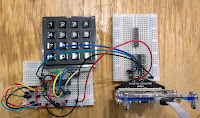
A working prototype I've now got a home-brew Arduino clone reading the keyboard and sending key-presses to a micro:bit using I2C. Preparing the Arduino clone was trickier than usual. As I mentioned in yesterday's post , the Arduino needs to run at 3.3 volts. That's the working voltage (V cc ) for the micro:bit, the Pi and the Jetson Nano. Connecting I2C lines from a 5v device would damage them, so 3.3 v operation is essential. I have a good stock of ATmega328P chips left over from the days when I was running Shrimping workshops. The ATmega328P  works well at 3.3 volts, so long as the clock frequency is no more than 8 MHz . Most Arduinos run at 5v with a clock speed of 16 MHz, so there's work to do.   8 MHz clock issues If I2C is to work reliably at 8 MHz the Arduino needs to be configured for an 8 MHz clock, and it needs a bootloader that works at that clock rate. My first step was to wire up a working clone on a breadboard with an 8 MHz crystal and i...

Adding a DS1307 Real Time Clock to Raspberry Pi

Image
Grove RTC The DS1307 RTC (Real Time Clock) is widely available, but adding one to a Raspberry Pi turned out to be a bit of a Yak shave. I'm gradually adding code and wiring instructions to my babelboard hardware and software projects, and I thought it was time to cover an RTC. I had a Grove RTC board from years ago and decided I'd document connecting that to a Raspberry Pi. The need for Battery Power First Yak Shave moment: RTCs normally use a coin battery to maintain power so they can keep time when their host is off, and the battery in my Grove board was way past its use-by date. This happened on Sunday evening, and the local supermarkets were shut, but the local convenience store was open. No CR1220, though, so I had to wait until the next day to get started. While I was waiting I read the data sheet for the DS1307 chip and realised I had another problem. Don't connect this chip directly to your Pi! Seeed Studios describe the DS1307 breakout as P...

I2C and SPI on the micro:bit; additions to the babelboard range

Image
micro:bit Keypad using I2C+ MC23008 For some reason there's not a lot on the web about using I2C and SPI with the BBC micro:bit. The I2C and SPI protocols allow single board computers like the micro:bit, the Raspberry Pi and Jetson Nano to drive hundreds of different types of useful peripheral chips. There are lots of widely available drivers for the Raspberry Pi, the Arduino and  Adafruit boards. I've seen fewer for the micro:bit, and I have started writing some more as part of my babelboard project . I am also building a babelboard for the micro:bit. The babelboard project Babelboards allow you to connect a range of I2C and SPI devices to several popular single board computers. The image on the right shows an mcp23S08 reading a hex keypad driven by a micro:bit using SPI. The micro:bit babelboard allows you to connect Grove I2C devices and the Quick2Wire port expander and analog boards. You can get adapters that connect Grove to Qwiik , so you can also con...