Posts

Showing posts with the label #C3Pi

Raspberry Pi and BBC micro:bit for C2Pi

Image
Right now the Raspberry Pi and the BBC micro:bit look like a winning team. If you're f ollowing this blog you will know that I am evaluating new hardware and software for C2Pi (the re-generated C3Pi, neé Trackbot). Over the weekend I discovered that the micro:bit now supports MicroPython. Since I am looking for a micro that supports a language with a REPL, I had to investigate. MicroPython on the pyboard I've been a fan of MicroPython for a while. It runs on several platforms, including a custom board (the pyboard). I first met the pyboard, and Damien George, (its designer, and the original implementer of MicroPython) at an Open Technology conference in Cambridge a couple of years ago. I learned that MicroPython is a full, optimised implementation of Python 3; the only difference lies in MicroPython's specialised libraries, which  focus on direct access to the hardware. At the time I felt that the pyboard and MicroPython had great potential but I couldn...

Embedded development is faster with a REPL

Image
In my previous post I mentioned that I was frustrated by the slow pace of Arduino-style development and that I was looking at using a language with a REPL (Read-Evaluate-Print loop). A REPL is just a fancy name for an interactive environment. You can type an expression and have the computer evaluate it; the computer display the result immediately. (If you've ever used Python interactively you'll know exactly what I mean). Why REPLs are great REPLs give you immediate feedback. If you've done something right, you get an immediate reward. If you've made a mistake, you get to fix it while everything is still fresh in your mind. I find it makes for much faster progress, particularly if I am using hardware or software I haven't used before. They also give you a chance to do some stunning demos. Here's a video of two Dyabots dancing, courtesy of Morten Kromberg (CXO of Dyalog). A tale of two REPLs  C3Pi and Dyabot have two computers on board; a Pi to do ...

C3Pi regenerates!

Image
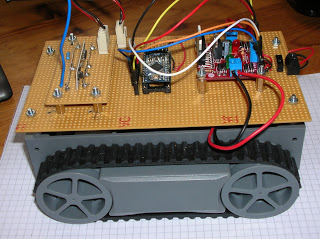
My old friend C3Pi, like Doctor Who, regenerates from time to time. He started life as Trackbot - a tracked robot, powered by an Arduino Nano, with fairly limited capabilities. Some years later he acquired a Raspberry Pi, and replaced the Nano by a Teensy 3.1. C3Pi has proved a good subject for experiments, as did the Dyabots - the mobile robots built by Dyalog to experiment with APL as a control language for robotics. But... The C3Pi and Dyabot designs had their limitations, and it's time to apply the lessons learned. Issues with C3Pi and Dyabot Several factors have stopped me achieving all I want to with the old version of C3Pi. I found it awkward to recharge or replace C3Pi's batteries. C3Pi’s limited room made it hard to add new capabilities. The Pi was a veteran model 2 B+; C3Pi would benefit from the processing power of the Pi 3. I found the Teensy disconnect-compile-upload-reconnect-test cycle frustratingly slow . The motor control...