Posts

Showing posts with the label #robotics

Getting started with Pimoroni's Tiny 4WD Rover
Image
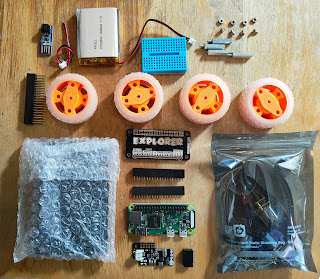
Kit contents with extras I just finished my book on the Pimoroni Explorer HAT, and I'm celebrating! I have treated myself to a Tiny 4WD Rover kit. It looks a lot of fun, and should be simple to assemble. The product page has a link to a great blog post from Emma Norling which has detailed build instructions. I'll be following that closely. I have already encountered one  minor gotcha . You need a few extras over and above the parts in the kit. Some of them are mentioned on the product page (battery, Pi zero W), but Emma found she needed spacers to mount the Explorer pHAT on the Pi zero W. I have suitable spacers in stock so I think I'll be OK. I also got a LIPO shim and a USB charger. Once I've completed the build I'll document it and provide a link on this blog. A nice bonus if you hurry!  Pimoroni are currently offering a free Pi Zero WH for customers spending more than £100 (excluding postage). The offer ends soon, but I managed to get my order in on time whic...

Embedded development is faster with a REPL

Image
In my previous post I mentioned that I was frustrated by the slow pace of Arduino-style development and that I was looking at using a language with a REPL (Read-Evaluate-Print loop). A REPL is just a fancy name for an interactive environment. You can type an expression and have the computer evaluate it; the computer display the result immediately. (If you've ever used Python interactively you'll know exactly what I mean). Why REPLs are great REPLs give you immediate feedback. If you've done something right, you get an immediate reward. If you've made a mistake, you get to fix it while everything is still fresh in your mind. I find it makes for much faster progress, particularly if I am using hardware or software I haven't used before. They also give you a chance to do some stunning demos. Here's a video of two Dyabots dancing, courtesy of Morten Kromberg (CXO of Dyalog). A tale of two REPLs  C3Pi and Dyabot have two computers on board; a Pi to do ...

C3Pi regenerates!

Image
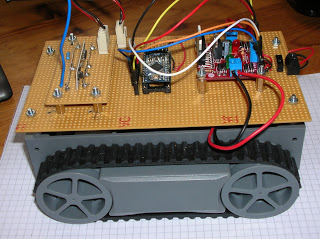
My old friend C3Pi, like Doctor Who, regenerates from time to time. He started life as Trackbot - a tracked robot, powered by an Arduino Nano, with fairly limited capabilities. Some years later he acquired a Raspberry Pi, and replaced the Nano by a Teensy 3.1. C3Pi has proved a good subject for experiments, as did the Dyabots - the mobile robots built by Dyalog to experiment with APL as a control language for robotics. But... The C3Pi and Dyabot designs had their limitations, and it's time to apply the lessons learned. Issues with C3Pi and Dyabot Several factors have stopped me achieving all I want to with the old version of C3Pi. I found it awkward to recharge or replace C3Pi's batteries. C3Pi’s limited room made it hard to add new capabilities. The Pi was a veteran model 2 B+; C3Pi would benefit from the processing power of the Pi 3. I found the Teensy disconnect-compile-upload-reconnect-test cycle frustratingly slow . The motor control...