Posts

Showing posts with the label GPIO

Raspberry Pi and BBC micro:bit for C2Pi

Image
Right now the Raspberry Pi and the BBC micro:bit look like a winning team. If you're f ollowing this blog you will know that I am evaluating new hardware and software for C2Pi (the re-generated C3Pi, neé Trackbot). Over the weekend I discovered that the micro:bit now supports MicroPython. Since I am looking for a micro that supports a language with a REPL, I had to investigate. MicroPython on the pyboard I've been a fan of MicroPython for a while. It runs on several platforms, including a custom board (the pyboard). I first met the pyboard, and Damien George, (its designer, and the original implementer of MicroPython) at an Open Technology conference in Cambridge a couple of years ago. I learned that MicroPython is a full, optimised implementation of Python 3; the only difference lies in MicroPython's specialised libraries, which  focus on direct access to the hardware. At the time I felt that the pyboard and MicroPython had great potential but I couldn...
Raspberry Pi Model B+ version detection

Image
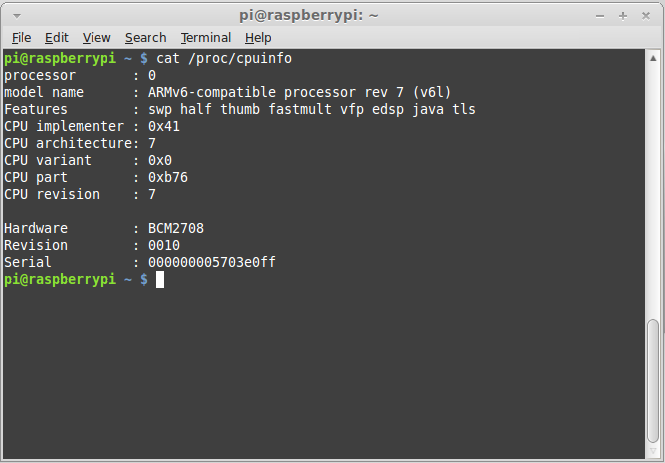
First, the good news. Existing code that relies on my revision detector script will work with Raspberry Pi Model B+. I'd forgotten how hacky my version detection code was. It assumes that if a board isn't revision 1, it must be revision 2. Here's the contents of /proc/cpuinfo for the new boards >> So the current detector thinks that boards are rev 2, and existing code will work because the layout for the first 26 pins on the Raspberry Pi header has not changed. What the current code won't do is let you know that you've got an extra 14 pins to play with. Fixing this requires two sorts of change: one to the detector (which is easy) and one to whatever code is using it. I'll take a look later in the week at what work will be needed to get the Quick2Wire GPIO code to give access to the extra pins, but before that I will check that current I2C code works OK. That too will need a (trivial) change to work correctly with a version of the detector th...

Raspberry Pi Model B+ first impressions

Image
and a worry! Farnell element14 have just delivered my new Raspberry Pi Model B+, along with some 40-way connectors. The Pi is destined for C3Pi , my Pi+ Arduino tracked robot. The main benefits of the Raspberry Pi B+ for C3Pi are the extra USB sockets and the reduced power consumption. I can see all sorts of possibilities created by the 40-way extended GPIO header, but I don't expect to take advantage of those in C3Pi. Unboxing the Raspberry Pi model B+ Raspberry Pi Model B+ Here is the Pi model B+. It's familiar, yet subtly different from its predecessors. It has a neater look about it and the 2x20 rows of GPIO pins are clearly ready for some serious work. I have one big question, which I hope to answer shortly: what is the hardware revision of the new board? Will some Python libraries crash on the Model B+? The board revision matters more than you might think. Back in the days when I was running Quick2Wire I came up with a little Python script you cou...