Posts

Showing posts with the label mbed

A lesson from the mbed

Image
Yesterday in a short post about I2C  I published a fragment of code for the mbed. I wondered at the time why I was posting here rather than on the very helpful mbed site. Here's why. Take a look at the code, and think about the library it's using. The mbed I2C library is about as simple as you could wish for, but it does everything you need. You can even specify the I2C data rate at run time. On other platforms that small change is a big deal; Arduino requires you to recompile the Wire library, and the BeagleBone requires you to recompile  the kernel. The mbed library for SPI is just as good as its I2C library: simple, intuitive and complete . That's what we need on the BeagleBone and Raspberry Pi . We've been waiting for userland SPI support on the BeagleBone for a while, and we seem to be getting a mixed message from the kernel developers: It's really hard to do SPI right, and it will take a while It's done already; all you have to do...

Java USB HID client for mbed Logic analyser

Image
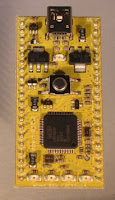
mbed lpc11u24 beta kit I've been using a Python client while developing my mbed USB-based logic analyser , but the pywinusb package only runs under Windows. Since my desktop is now a Windows-free zone, I've been having to Fire up VirtualBox Start up a Windows XP VM Plug a USB connector into the mbed Tell VirtualBox to give the VM access to that USB device and Curse at the fact that I'm restricted to the much slower version 1.1 of the USB protocol I've now switched to a Java package which runs under Ubuntu. Details on the mbed site . The next step should be to do some timings, but I won't be able to run at full speed until the chaps at mbed have finished porting one of the libraries I need to the new beta mbed LPC11U24.

Progress on the mbed Logic Analyser

Image
LPC11U2 mbed I'm making steady progress on my Logic Analyser project for the new beta version LPC11U24 mbed . So far everything has worked as it should, although one or two libraries are still being ported to the new device. I can already send the state of an 8-bit wide set of mbed inouts to the PC over a USB HID connection. I have now idea how fast the final version will be, but it should be able to analyse fast  (400kHz) I2C and some SPI interactions in real time. Hendrik Lipka (another mbed user) suggested that I might adapt the open-source SUMP client  so that it can capture, analyse and display data on the PC. That's an exciting idea which I will certainly follow up.

mbed - USB made easy!

Image
mbed nxp LPC11U24 I'm having great fun with the new mbed . Just working my way through the examples so far, and everything is working well. The photo show the mbed pretending to be a USB mouse. I'm looking forward to getting stuck into my logic analyser project ; once that is finished I may hook the mbed up to my pseudo-microwriter and turn it into a USB device.

The new mbed m0 has arrived!

Image
I mentioned a few days ago that a new mbed was on its way . It's still in beta, but I was lucky enough to be selected for the beta program and I am starting work on my project . First impressions are very positive: the instructions on the mbed site are very clear. It took about two minutes to use the cloud-based compiler to create the obligatory led blinking program and then drag the binary file over to the mbed. Now to work through the examples and test it out as a USB device.

A fast logic analyser using the new mbed cortex-m0

Image
I've just heard that I have been accepted for the beta test program for the new mbed cortex-m0 . I'm going to build a logic analyser which transfers data  via the USB interface to a PC for analysis and display. While one can do this using the existing mbed and serial communication's, I think the USB approach should support significantly higer data rates. I've set up a new project page in my notebook at mbed.org. Comments and suggestions welcome!

The new mbed is coming

Image
mbed (courtesy of NXP) Last year marked the debut of the mbed - an ARM-based System-on-a-chip from NXP in a compact 40-pin DIL format. I was lucky enough to be selected to do a road-test for Farnell's element14 . The mbed is an amazing product. One of its great strengths is the large support library which includes code developed by the mbed team and by its users. With I2C, SPI and Serial suport, and a full set of GPIO pins, it's easy to interface to external devices, and the web-based compiler means that you can program the device within 5 minutes of opening the box. Now a second mbed is in beta-test. Based on the NXP LPC11U24, it    is designed for prototyping USB devices, battery powered applications, and 32-bit ARM Cortex-M0 designs. I'm hoping to get my hands on one soon and will report in due course. The original mbed is still selling well, and is available from Farnell for just under £40 + VAT.